


What Metabolic Breath Testing Actually Reveals (And What I Found When I Tested Myself)
- Dr. Shukhman
- Feb 4, 2025
- 6 min read
By Dr. Jeffrey Shukhman, DO | White Olive Concierge Personalized Care | Woodland Hills, CA

I've been active my entire life. Hockey, wrestling, boxing. I eat carefully, stay consistent, and pay closer attention to my health than most people do. So when I ran a metabolic breath test on myself using the PNOĒ system, I expected the results to confirm what I already believed about my fitness.
They didn't.
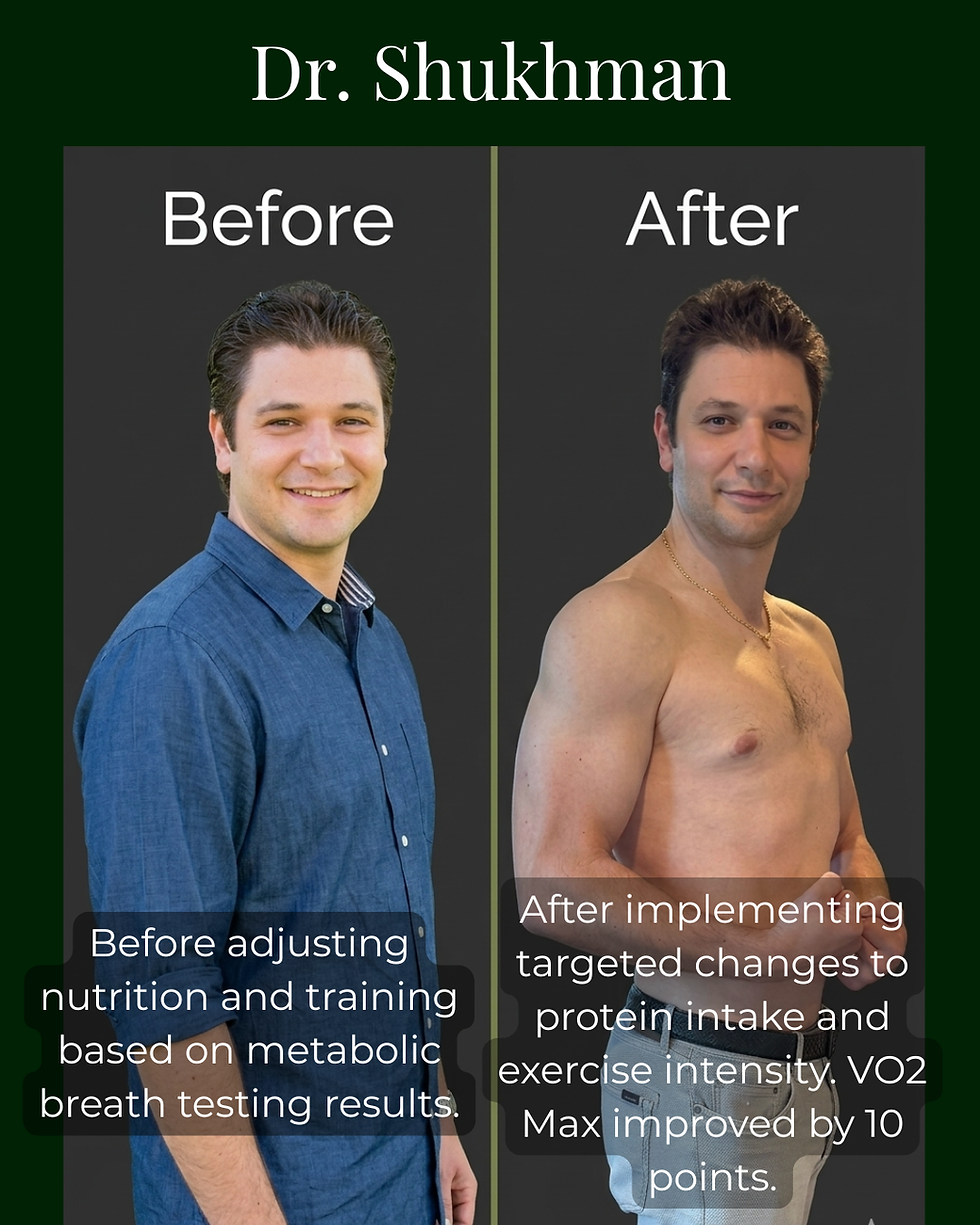
My diet wasn't supporting my metabolism the way I thought. My VO2 Max was lower than it should have been for my activity level, and my protein intake wasn't matched to what my body actually needed. After making specific, targeted adjustments based on the data, my VO2 Max improved by 10 points.
That experience is part of why metabolic breath analysis has become a core part of how I practice at White Olive.
What Is Metabolic Breath Analysis?
Metabolic breath analysis measures how your body processes oxygen and fuel in real time. Using the PNOĒ system, the same technology used by NASA researchers and Olympic training programs, we can assess three things standard lab panels simply cannot tell you:
VO2 Max: How efficiently your heart and lungs deliver oxygen to working muscles. This is one of the strongest predictors of long-term health and longevity in the medical literature.
Resting Metabolic Rate (RMR): How many calories your body burns at rest, and whether your current diet is actually supporting that baseline or working against it.
Respiratory Quotient (RQ): Whether your body is burning fat or carbohydrates as its primary fuel source, and how well it shifts between the two.
Together, these three data points create a metabolic profile that is specific to you. Not a population average. Not a formula based on your age and weight. Actual measurements from your own physiology.
Why VO2 Max Is One of the Most Important Health Numbers You Can Track
Most people who exercise regularly and eat thoughtfully assume their metabolism is working for them. My own test results showed me how wrong that assumption can be.
The issue is not effort. The people I see at White Olive are motivated. They work out. They try to eat well. But without metabolic data, they are optimizing for the wrong variables. They are training at the wrong intensities. They are eating the wrong amounts of protein. They are burning sugar when they should be burning fat, or vice versa.
A 10-point improvement in VO2 Max is not a small thing. Research consistently shows that each 1-unit increase in VO2 Max is associated with a meaningful reduction in cardiovascular mortality risk. For long-term health, VO2 Max is one of the most important numbers you can track.
What the Testing Process Looks Like

A metabolic breath test at White Olive takes about 15 to 20 minutes. You wear a lightweight mask connected to the PNOĒ device, which captures the composition of every breath you exhale. The test begins at a comfortable pace and gradually increases in intensity.
There is no guesswork and no discomfort beyond normal exertion. When it is done, we review the full analysis together, and I translate the data into specific, practical changes to your nutrition and exercise plan.
This is not a generic report. The recommendations you leave with are built entirely around your numbers.
Metabolic Breath Testing Results: A Patient Example
One of my patients, a 47-year-old from Calabasas, had been stuck at a fitness plateau for over a year despite working with a personal trainer three times per week. Her workouts were consistent. Her diet was reasonable. Nothing was moving.
Her metabolic breath test revealed she was training almost exclusively in a carbohydrate-burning zone, which was limiting fat adaptation and keeping her metabolism less flexible than it should be. Her protein intake was also below what her lean mass required to maintain and grow muscle.
We adjusted her training intensities and her protein targets based on the data. Within 12 weeks, her body composition had shifted meaningfully, her energy levels improved, and she had dropped the plateau entirely.
The variables we changed were small. The difference was in having the right information to change the right things.
Who Benefits Most from Metabolic Breath Testing
This type of testing is useful across a wide range of situations. It is particularly valuable if:
You exercise regularly but are not seeing results that match your effort
You have hit a weight loss plateau that diet and exercise adjustments have not resolved
You want to understand how your metabolism is actually functioning, not just how it should be functioning based on population averages
You are focused on longevity and want objective data on one of its most important biomarkers
You are recovering from a health issue and want to return to exercise with a plan built around your current physiology
Patients from Calabasas, Hidden Hills, Agoura Hills, Malibu, Westlake Village, Woodland Hills, and West Hills have access to this testing directly through White Olive. It is available as part of a concierge membership or as a standalone consultation.
Metabolic Testing Through Concierge Medicine: What Makes It Different
At White Olive, metabolic breath testing is not a standalone service you complete and take home as a PDF. It is part of an ongoing conversation about your health.
I review the results with you directly. We build a plan together. And as you implement changes, we track whether your metabolism is responding the way we expect. That kind of continuity is what concierge medicine is designed for.
Standard medicine does not have time for this. A 15-minute appointment cannot accommodate a detailed metabolic analysis and a personalized exercise and nutrition plan.
Concierge care can.
Take the Next Step
If you want to understand how your metabolism actually works and what changes would make the most difference for your energy, body composition, and long-term health, metabolic breath testing is a logical starting point.
Download the free Metabolic Health Guide: https://www.whiteolivedpc.org/metabolichealth
Book a concierge consultation: https://whiteolivedpc.hint.com/booking?appointment-type=appty-3f38c564fbe91cb2
Frequently Asked Questions About Metabolic Breath Testing
How long does a metabolic breath test take? The test itself takes 15 to 20 minutes. Plan for about 45 minutes total for the appointment, which includes a brief intake, the test, and a review of your results with me directly. You will leave with a clear picture of your metabolic profile and a specific set of next steps.
How much does metabolic breath testing cost? For White Olive concierge members, metabolic breath testing is included as part of your membership. For non-members, it is available as a standalone consultation. Contact our office for current pricing or book a call to discuss which option makes the most sense for your situation.
Is metabolic breath testing covered by insurance? Most insurance plans do not cover metabolic breath testing, as it falls outside standard preventive care billing. White Olive operates as a concierge practice, which means we work outside the insurance billing system entirely. This allows us to spend real time with you on your results rather than rushing through a visit to meet reimbursement requirements. Many patients find the out-of-pocket cost reasonable given what the data produces.
How is PNOĒ different from a standard VO2 max test? A standard VO2 max test typically measures peak aerobic capacity during maximal effort exercise. The PNOĒ system does that and more. It also measures your resting metabolic rate and respiratory quotient, which tell you how your body burns fuel at rest and during different exercise intensities. The result is a complete metabolic picture, not just a single fitness number. For most people looking to improve body composition, energy, or longevity, the resting and submaximal data is actually more actionable than the VO2 max number alone.
How often should I retest? For most patients, retesting every 3 to 6 months gives a meaningful picture of how your metabolism is responding to changes in nutrition and training. After your first test establishes a baseline, follow-up tests let us confirm whether the adjustments we made are producing the results we expected, and refine the plan if needed.
Dr. Jeffrey Shukhman, DO, is board-certified in internal medicine and obesity medicine. He practices concierge personalized care at White Olive in Woodland Hills, serving patients throughout Calabasas, Hidden Hills, Agoura Hills, Malibu, Westlake Village, Woodland Hills, and West Hills.
References
VO2 Max as a Predictor of Longevity Kokkinos P, et al. "Cardiorespiratory Fitness and Long-Term Survival After Heart Surgery." JAMA, 2009. Higher VO2 Max is consistently associated with improved long-term survival and reduced risk of chronic disease.
VO2 Max and Cardiovascular Risk Myers J, et al. "Role of VO2 Max in Cardiovascular Risk Assessment." Circulation, 2003. VO2 Max serves as an objective early indicator of cardiovascular disease risk and aerobic capacity.
VO2 Max, Weight Management, and Metabolic Health Ross R, et al. "VO2 Max and Metabolic Health: Exercise Prescription for Obesity and Diabetes." Medicine & Science in Sports & Exercise, 2011. Improved aerobic capacity supports fat loss, insulin sensitivity, and diabetes prevention.
VO2 Max and Chronic Disease Prevention Laukkanen JA, et al. "Maximal Oxygen Uptake and the Prevention of Chronic Diseases." European Heart Journal, 2018. Higher VO2 Max is associated with lower incidence of hypertension, stroke, and type 2 diabetes.


Comments