


3 Longevity Markers Most Annual Physicals Never Check
Dr. Jeffrey Shukhman, DO | White Olive Personalized Care | Woodland Hills, CA
When a patient tells me they want to age well, I am not reaching for their cholesterol panel. I am looking at three longevity markers most people have never had measured.
A standard annual physical captures a narrow slice of your health. It tells you where you are today. What it almost never tells you is where you are headed. The longevity markers that actually predict long-term health outcomes and how well your body handles fuel, how efficiently your heart and lungs work, how much muscle you are carrying into your later decades and rarely appear on a routine lab order.
That gap matters. Because the earlier you identify a problem with any of these markers, the more you can do about it. Here is what I look at instead, and why each one matters.
What Does Muscle Mass Have to Do With How Long You Live?

Not your weight. Not your BMI. Your actual muscle tissue.
Muscle is the primary site of glucose disposal in the body. When you eat, your muscles are responsible for clearing most of the sugar from your bloodstream. More muscle means better insulin sensitivity, lower blood sugar burden, and a more metabolically resilient body overall. It is one of the most underappreciated longevity markers in routine clinical care.
The problem is that muscle mass declines with age — a process called sarcopenia — and most people have no idea it is happening. Weight can stay stable while muscle quietly disappears and is replaced by fat. A normal BMI tells you nothing about that shift. A standard blood panel does not catch it either.
"Weight can stay exactly the same while muscle disappears underneath. A standard physical misses it entirely."
A 2014 study published in the American Journal of Medicine found that muscle mass index was a significant predictor of longevity in older adults, independent of fat mass — meaning it mattered on its own, not just as a proxy for overall fitness. Read the study.
Measuring muscle mass directly via DEXA scan or bioimpedance (such as my SECA scale in office) gives me a much more accurate picture of where a patient stands metabolically and what their trajectory looks like over the next decade. It also gives us something specific to work on. Muscle is trainable at any age. The earlier we catch a deficit, the more we can do about it.
Why Is Fasting Insulin a Better Longevity Marker Than Blood Sugar?

Most labs measure blood sugar. What they miss is the insulin required to keep that blood sugar normal.
Here is what that means in practice. Your body can compensate for declining insulin sensitivity by simply producing more insulin. For years and sometimes more than a decade, your glucose numbers look perfectly fine on a basic metabolic panel. But fasting insulin is quietly running high, doing extra work to hold everything together. This is one of the most clinically significant longevity markers that almost never gets ordered on a routine panel.
By the time blood sugar becomes abnormal, the underlying problem has usually been developing for a long time. Standard screening catches the late stage. Fasting insulin catches the early one. And that window is exactly where intervention is most effective.
"Fasting insulin can be elevated for ten years before blood sugar shows anything unusual. Most patients have no idea."
Elevated fasting insulin is also independently associated with increased cardiovascular risk, chronic inflammation, and difficulty maintaining a healthy body composition. It is one of the cleaner early signals that something is off metabolically. If you want to understand your metabolic health in more depth, our metabolic health guide walks through what to look for and what optimal actually means.
Why Is VO2 Max One of the Strongest Predictors of Lifespan?
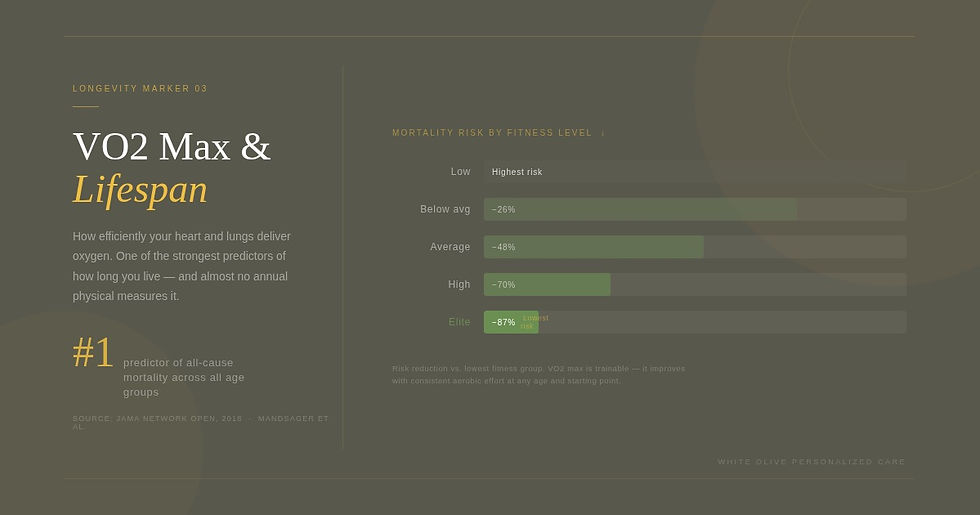
VO2 max measures how efficiently your heart and lungs deliver oxygen to your muscles when you push yourself. It is a direct measure of cardiorespiratory fitness, and it is one of the most consistently powerful longevity markers in the research literature.
A landmark 2018 study in JAMA Network Open found that low cardiorespiratory fitness was associated with higher long-term mortality risk than smoking, hypertension, or diabetes — and that each improvement in fitness level corresponded to a meaningful reduction in risk at every age group studied. Read the Study.
NUMBERED LIST:
1. Low VO2 max is strongly associated with all-cause mortality across every age group studied.
2. Each meaningful improvement in fitness category corresponds to a significant reduction in risk.
3. The gains are achievable regardless of starting point — including in patients who have never trained consistently.
Despite this evidence, almost no annual physical measures VO2 max. It does not fit into a 15-minute visit, and it requires either a formal exercise test or a validated submaximal protocol. Most patients have never heard of it. Almost none have a number. And unlike some risk factors, cardiorespiratory fitness is highly modifiable — it improves significantly with consistent, structured aerobic effort.
Why Don't Most Doctors Order These Longevity Markers?
None of these are exotic biohacker tests. They are basic clinical measures with strong evidence behind them. What they share is that they capture trajectory, not just a snapshot. They tell me where your health is headed, not just where it stands today.
They also give us something to act on. Muscle mass can be built. Insulin sensitivity can be improved with training, nutrition, and sometimes targeted intervention. VO2 max responds well to consistent aerobic work. These are not passive numbers to observe. They are targets to move.
The reason most patients have never had these longevity markers measured is not that they are inaccessible. It is that the standard care model does not have time for them. A 15-minute annual visit is designed to screen for acute problems, not to build a detailed picture of long-term health.
That is exactly the gap that concierge personalized care is designed to close. If you are in the Woodland Hills, Calabasas, or West Valley area and want a physician who has the time to actually look at the full picture, we would be glad to talk.
FAQs
Q: What are longevity markers?
A: Longevity markers are clinical measurements that predict long-term health outcomes and lifespan — beyond what a standard annual physical captures. Key longevity markers include muscle mass (measured by DEXA or bioimpedance), fasting insulin (a sensitive early marker of metabolic dysfunction), and VO2 max (a measure of cardiorespiratory fitness and one of the strongest predictors of all-cause mortality in the research literature).
Q: What is a normal fasting insulin level?
A: Most labs flag fasting insulin as abnormal above 25 uIU/mL, but optimal is considerably lower. Many longevity-focused physicians look for fasting insulin below 8–10 uIU/mL as a sign of healthy insulin sensitivity. Levels that appear "normal" by standard reference ranges can still indicate early metabolic dysfunction when viewed through a preventive lens.
Q: How do I get my VO2 max measured?
A: VO2 max can be measured formally via a maximal exercise test (typically on a treadmill or bike with a metabolic cart), or estimated through validated submaximal protocols and certain wearable devices. A concierge or preventive medicine physician can order the appropriate test and interpret your results in the context of age-matched norms and longevity research.
Q: How is muscle mass measured?
A: The gold standard is a DEXA (dual-energy X-ray absorptiometry) scan, which gives a precise breakdown of lean mass, fat mass, and bone density by body region. Bioelectrical impedance analysis (BIA) is a practical clinical alternative. Standard scales and BMI calculations do not measure muscle mass and should not be used as a proxy for it.
Want to know your numbers?
Schedule a consultation with Dr. Shukhman to review what your current labs are telling you and what they are not.
REFERENCES
Srikanthan P, Karlamangla AS. Muscle Mass Index as a Predictor of Longevity in Older Adults. American Journal of Medicine. 2014;127(6):547-553.
Mandsager K, et al. Association of Cardiorespiratory Fitness With Long-term Mortality Among Adults Undergoing Exercise Treadmill Testing. JAMA Network Open. 2018;1(6):e183605.
Kodama S, et al. Cardiorespiratory Fitness as a Quantitative Predictor of All-Cause Mortality and Cardiovascular Events in Healthy Men and Women. JAMA. 2009;301(19):2024-2035.
Dr. Jeffrey Shukhman, DO
White Olive Direct Personalized Care · Woodland Hills, CA · Serving Calabasas, Hidden Hills, Malibu, Westlake Village & the West Valley

Comments