


What Does a Longevity Doctor Actually Do?
- Dr. Shukhman
- Feb 24
- 5 min read
Updated: May 3
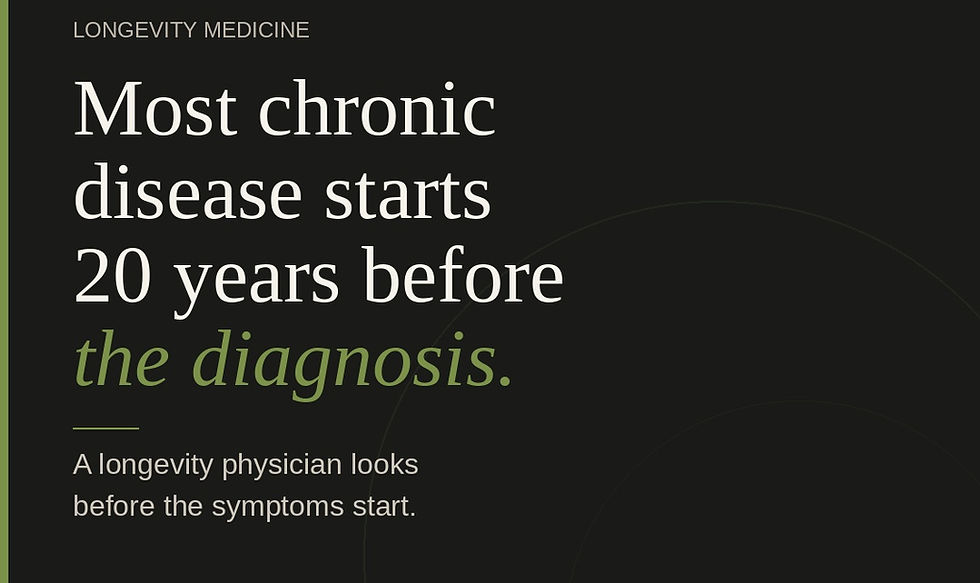
Most people who will develop a serious chronic disease in their 60s or 70s have early signals showing up in their 40s. The question is whether anyone is paying close enough attention to see them.
If you have wondered what a longevity doctor actually does, not in theory but in practice, this post explains it directly. It is not about supplements or biohacking. It is about catching the slow drift toward chronic disease early enough to change where things are heading.
What is longevity medicine and what does it actually focus on?
Longevity medicine is the practice of identifying metabolic and physiological patterns that precede chronic disease and intervening before those patterns become irreversible.
The diseases that shorten and diminish life almost always develop quietly over decades. Research tracking metabolic risk factors confirms that unfavorable patterns are present 15 to 20 years before cardiovascular disease is diagnosed, meaning the window to act is long before any symptom appears.
Standard medicine is organized around diagnosis. Longevity medicine is organized around trajectory. Those are very different things.
What does a longevity doctor actually look at that a standard doctor doesn't?
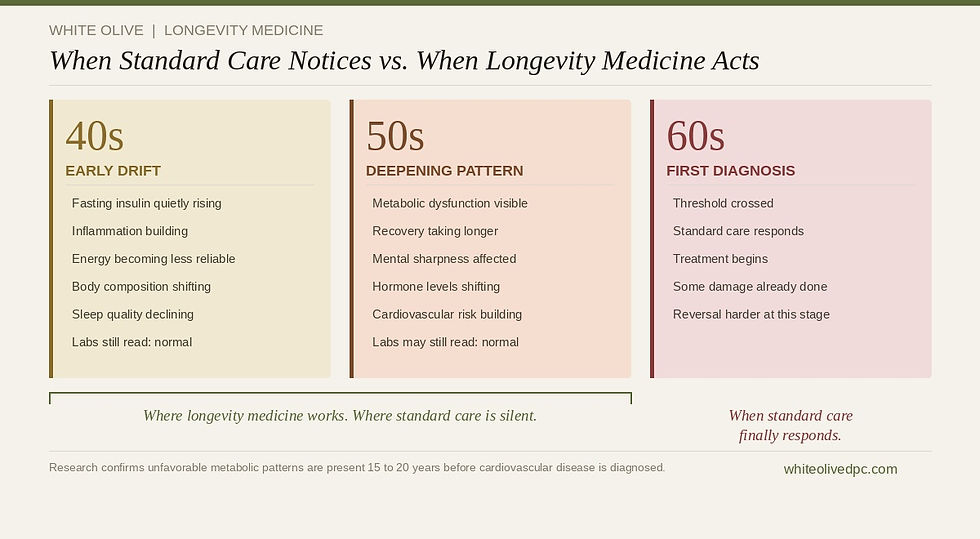
The gap between standard care and longevity care is not about exotic testing. It is about which questions get asked and which patterns get connected.
A standard annual visit checks fasting glucose, A1c, basic cholesterol, and TSH. These are designed to catch disease that has already arrived. They are not designed to catch the years of metabolic drift that precede it.
A longevity physician looks at a different set of questions. Fasting insulin rather than just glucose, because insulin resistance is detectable years before blood sugar becomes abnormal. High-sensitivity CRP for inflammatory load. A full thyroid panel rather than just TSH. Sex hormones and how they are changing over time. Body composition, specifically muscle mass rather than just weight. Sleep quality. Cardiovascular risk markers beyond a basic lipid panel. Stress physiology and how it is affecting recovery.
None of these are fringe tests. They are simply the markers that standard panels leave out because the system is not built to look this early.
Who actually needs a longevity doctor?
Not just older patients. The people who benefit most from this kind of care are high-functioning adults in their 40s and 50s who feel mostly fine but are starting to notice things that do not match what they expect of themselves.
Energy that used to be reliable is now inconsistent. Body composition is shifting despite the same habits. Recovery from stress or illness takes longer. Sleep is lighter. Mental sharpness feels slightly off in a way that is hard to describe.
These are early signals. They show up years before anything would flag on a standard panel. Most standard care dismisses them because there is nothing to diagnose yet. Longevity medicine takes them seriously because that is exactly when intervention is most effective.
The patients I see from Calabasas, Hidden Hills, Westlake Village, Agoura Hills, and Malibu are typically high-functioning people who manage demanding lives well. What brings them in is a quiet sense that the trajectory has shifted and that their current care has not looked closely enough to explain why.
What does this look like in practice at White Olive?
It starts with time. A visit long enough to actually take a history, review patterns over time, and understand what is driving what.
It means ordering the markers that actually reflect early metabolic function, not just the ones that insurance requires. It means looking at how things are changing over time, not just whether a number crossed a threshold today.
It means direct access. When something shifts between visits, you can reach me. There is no waiting two weeks for an appointment to ask a question that has a simple answer.
And it means a plan built around what is actually happening in your metabolism. Not a generic recommendation to eat better and exercise more. Something specific to your biology, your pattern, and your goals.
The goal is not to find a crisis. It is to make sure one does not develop.
Most people assume that feeling mostly fine means everything is fine. Sometimes it does. But the metabolic patterns that drive the most consequential health outcomes rarely announce themselves early. They drift quietly for years while everything looks normal on paper.
A longevity physician's job is to look earlier, more carefully, and with enough time to actually act on what they find.
If you want to understand where your metabolic health actually stands, book a free 15-minute intro call at https://whiteolivedpc.hint.com/booking?appointment-type=appty-3f38c564fbe91cb2
Frequently Asked Questions
What does a longevity doctor actually do?
A longevity physician looks for early metabolic and physiological patterns that precede chronic disease, before symptoms appear and before standard labs flag anything as abnormal. Research confirms that unfavorable metabolic patterns are present 15 to 20 years before cardiovascular disease is diagnosed, which means the window to act is long before most standard care would intervene. The job is to look earlier, more carefully, and with enough time to act on what is found.
How is a longevity doctor different from a regular primary care physician?
The difference is in what gets measured, how much time is spent, and what questions get asked. A standard annual visit is organized around catching disease that has already arrived. A longevity physician is organized around trajectory, looking at where things are heading rather than just where they stand today. That means markers like fasting insulin, high-sensitivity CRP, full thyroid function, sex hormones, body composition, and sleep quality that standard panels rarely include. Fasting insulin in particular is one of the most reliable early markers of insulin resistance and is almost never part of a routine panel.
Who benefits most from seeing a longevity doctor?
High-functioning adults in their 40s and 50s who feel mostly fine but notice subtle shifts. Energy that is less reliable, body composition changing despite the same habits, recovery that takes longer, sleep that feels lighter, mental sharpness that is slightly off. These are early signals. Most standard care dismisses them because nothing has crossed a diagnostic threshold yet. Longevity medicine takes them seriously because that is exactly when intervention makes the most difference.
What does longevity medicine actually involve at a practical level?
It starts with longer visits and enough time to review your full metabolic picture rather than a checklist. It involves targeted lab work that goes beyond the standard panel, direct access between visits, and a plan specific to your biology and pattern over time. The goal is not to find a crisis. It is to build a clear picture of your metabolic health early enough to make sure one does not develop.
Learn about our metabolic reset program: whiteolivedpc.com/metabolic-reset
Learn more about membership: whiteolivedpc.com/membership



Comments