


Why Counting Calories Doesn't Work for Metabolic Health
- Dr. Shukhman
- May 6
- 3 min read

You have been reading nutrition labels. Choosing the lower-calorie option. Watching portions and doing what you were told to do.
And your energy is still low. Your weight is not moving. Your last blood panel was not what you hoped for.
If you have been asking why counting calories doesn't work the way it should, the answer often comes down to what those calories are doing to your metabolism rather than how many there are.
This is one of the most common and frustrating patterns I see in patients from across the Woodland Hills, Calabasas, Hidden Hills and Westlake Village area. They are not eating carelessly. They are following conventional nutritional advice carefully. And their metabolic health is still working against them.
New research published in Nature Metabolism helps explain why. The problem, for many patients, is not how many calories they are consuming. It is what certain calories, specifically fructose, are doing to their metabolism in ways that no nutrition label captures.
Why Counting Calories Doesn't Work — What Fructose Actually Do?
Fructose is a sugar found in table sugar, high-fructose corn syrup, and many processed foods. Unlike glucose, which your body processes through normal metabolic pathways, fructose is handled almost entirely by the liver. At the levels most people consume it, the effects are significant and distinct from its calorie contribution alone.
There are four things worth understanding.
First, fructose bypasses the appetite signals that normally tell your brain you have eaten enough. You can consume a significant amount of fructose without triggering the satiety response that would follow the same caloric load from a different source.
Second, it promotes fat accumulation in the liver. Non-alcoholic fatty liver disease, which is increasingly common in patients with metabolic dysfunction, is closely linked to fructose consumption. Not simply to total calorie intake.
Third, it worsens insulin resistance. Chronically elevated insulin promotes fat storage and makes weight regulation significantly harder. This comes up with nearly every patient I see who is working on metabolic health.
Fourth, it raises uric acid in ways that drive systemic inflammation. This is a factor in cardiovascular risk, joint health, and metabolic function that most standard annual panels do not measure.
None of these effects appear on a calorie label.
Where Is Fructose Actually Hiding?
Most patients know to avoid soda and candy. What they are not accounting for is the fructose in foods that do not taste particularly sweet.
Pasta sauce. Flavored yogurt marketed as a health food. Protein bars. Salad dressing. Whole grain bread. Granola. These products routinely list high-fructose corn syrup or added sugar among the first four ingredients. Patients eating these foods while carefully tracking calories are creating a metabolic burden that their calorie count completely obscures.
This is why two people can eat the same number of calories and have entirely different metabolic outcomes. One is eating in a way that keeps insulin low and supports liver health. The other is not. And neither would know the difference based on the nutrition label alone.
Which Label Actually Matters?
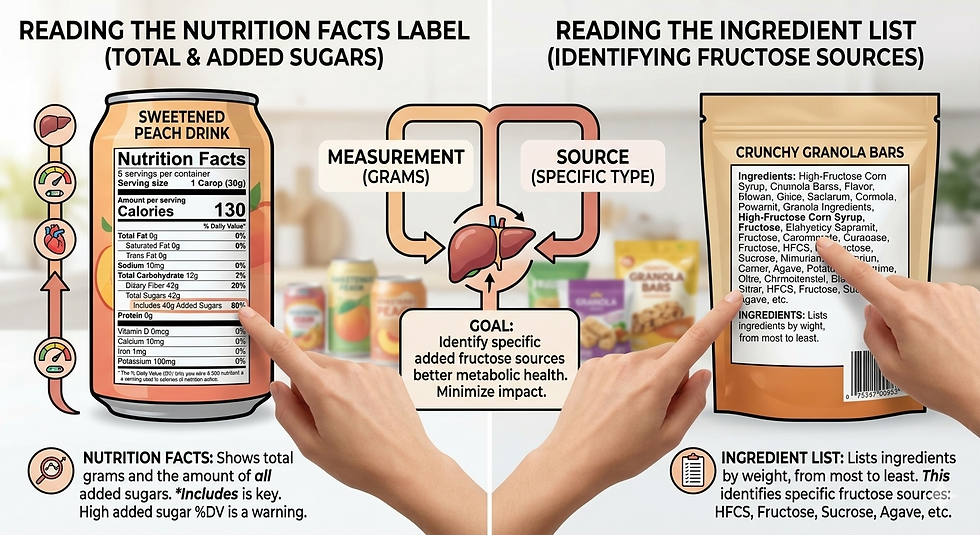
The most practical shift I recommend to patients focused on metabolic health is simple. Read the ingredient label before the nutrition label.
If sugar, high-fructose corn syrup, cane syrup, or any form of added fructose appears in the first four ingredients, that product is creating a metabolic burden independent of its calorie count. It is working against your insulin sensitivity, your liver health, and your long-term weight regulation, regardless of what the number on the front of the package says.
This does not mean avoiding all sugar permanently. It means understanding that metabolic health responds to the quality and source of food, not just the quantity. Calories count. But they are not the whole story, and for many patients, they are not even the most important part of the story.
I have a complimentary guide to Boost Your Metabolism in 30 Days. Or visit whiteolivedpc.com to learn more about how we approach metabolic health at White Olive.


Comments